

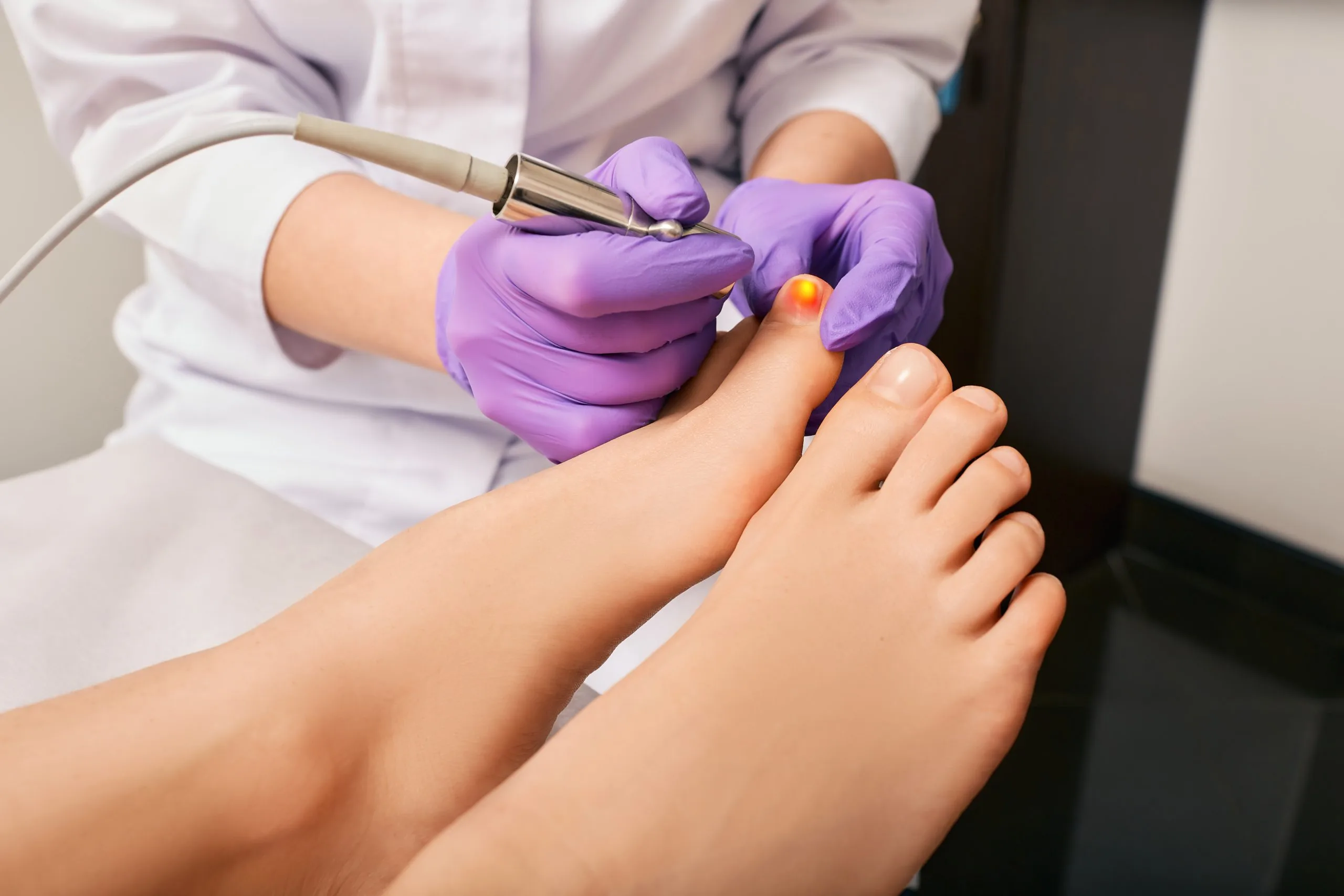
Modern laser treatment for toenail fungus typically involves advanced, FDA-cleared technologies, such as the Lunula “cold” laser and the Remy Class IV thermal laser, which target the fungus without damaging surrounding tissue. The type of procedure depends on the severity of your infection, your overall health, and how your nails respond to treatment.
At Silverstone Podiatry, our approach is to determine the ideal laser technology for your specific condition, ensuring a precise treatment plan.
Toenail fungus is caused by microscopic organisms – most commonly a group called dermatophytes, the same organisms responsible for common skin fungal infections. These fungi thrive in warm, dark, and moist environments, making shoes and socks the perfect breeding ground.
The fungus can enter the nail unit through tiny cracks in the nail or surrounding skin, separations between the nail and the nail bed, or other forms of micro-trauma. Once established, the infection feeds on keratin, the protein that makes up the hard structure of your nail. Reduced blood flow and slower nail growth in older adults make them more susceptible.
Common risk factors include:
Warm, damp footwear. Shoes that trap moisture create an ideal breeding ground. People who wear closed-toe shoes for long hours, including athletes and professionals on their feet all day, are especially vulnerable.
Heavy sweating. Hyperhidrosis creates a constantly moist environment.
Skin fungal infections. A history of skin fungal infections can allow the fungus to spread to the toenails.
Public spaces. Walking barefoot in gym locker rooms, swimming pools, and communal showers exposes your feet to fungi.
Nail damage. A stubbed toe, a dropped object, or repeated pressure from tight shoes can damage the nail plate enough to allow fungi to enter.
Underlying health conditions. Diabetes, peripheral artery disease, circulation problems, or a weakened immune system can impair the body’s ability to fight off infection.
Understanding the cause matters because it shapes the treatment strategy. A surface-level infection in an otherwise healthy person responds differently than a deep-seated fungal colony in someone with diabetes or circulation issues.
While it often begins as a small white or yellow spot under the tip of the nail, it can progress and cause more noticeable changes. Common signs include:
Discoloration – nails turn yellow, white, brown, greenish, or black
Thickening – the nail becomes abnormally thick and difficult to trim
Brittleness – edges crumble, crack, or become ragged
Distorted shape – the nail may warp or lift away from the nail bed
Debris buildup – fungal material accumulates under the nail, causing it to separate from the nail bed
Foul odor – a musty or unpleasant smell near the affected toe
Left untreated, toenail fungus can spread to other nails, to the skin between your toes, and even to fingernails. For individuals with diabetes or compromised immune systems, an untreated nail infection can serve as a gateway to more serious bacterial infections and cause permanent damage to the nail. If you are dealing with any foot condition alongside toenail fungus, getting a comprehensive evaluation from a podiatric specialist is especially important.
Laser therapy has emerged as the premier choice for treating toenail fungus because it directly addresses the shortcomings of older methods. It is a non-invasive procedure that targets the fungus at its source without the side effects of certain internal medications or the ineffectiveness of some external applications.
No systemic side effects. Unlike some internal medications, laser therapy does not pass through your liver or digestive system. This makes it appealing for patients who cannot tolerate certain medications or who take multiple prescriptions.
Direct targeting. Laser energy penetrates the nail plate to destroy the fungus living in the nail bed – something external applications cannot do.
Quick sessions. Most treatments take 15 to 30 minutes per session, and you can return to normal activities immediately.
No anesthesia required. Most laser devices used to treat toenail fungus do not require numbing injections or sedation.
High success rates. Clinical studies have consistently shown that laser therapy is highly effective at clearing fungal infections and promoting the growth of a new, healthy nail. This modern approach embodies Silverstone Podiatry’s commitment to integrating advanced technology to deliver seamless patient care.
Laser therapy for toenail fungus works on a straightforward principle: specific wavelengths of light energy penetrate the nail plate and reach the nail bed, where the fungal organisms reside. Depending on the type of laser, the mechanism falls into one of two categories:
Photothermal Ablation (Thermal Lasers). Devices like the Remy Laser are Class IV thermal lasers. They emit a focused beam of light energy that passes through the toenail. This energy is absorbed as heat by the pigmented fungal cells, raising their temperature to a level lethal to fungal organisms – typically around 40–60°C. The concentrated heat disrupts the cellular structure of dermatophytes and other fungi, effectively killing them or halting their reproduction.
Photobiomodulation (Non-Thermal or “Cold” Lasers). Devices like the Lunula Laser operate on a different principle. This cold laser uses two distinct low-level wavelengths of light that do not produce heat. One wavelength weakens and destroys fungal cell walls, while the second wavelength increases blood flow and stimulates the nail bed’s immune response. This dual-action approach not only fights the infection but also accelerates the growth of a healthy, clear nail.
Both approaches aim for the same goal: to clear the fungal infection so a healthy nail can grow in its place. However, the patient experience and treatment timeline differ between the two.
Yes. The FDA has cleared multiple laser devices for the “temporary increase of clear nail” in patients with onychomycosis. This clearance is granted only after rigorous clinical trials have demonstrated both safety and efficacy. Clinical studies show improvement rates ranging from about 60 to 80 percent or higher, depending on the device, the number of sessions, and the severity of the infection. When performed by a trained professional, the procedure is exceptionally safe.
It is worth noting that “clear nail” in clinical terms means visible improvement – not necessarily a 100 percent cosmetically perfect nail after a single round of treatment. Complete cosmetic clearance depends on the nail’s growth cycle, which can take 9 to 18 months for a toenail to fully replace itself.
The prospect of any medical procedure can be daunting, but laser treatment for toenail fungus is remarkably straightforward and convenient. At our New York offices, we prioritize a seamless patient experience, from digital scheduling to treatment.
A single laser session is surprisingly quick:
Lunula Laser. A session involves placing your foot in the device for a pre-programmed 12-minute cycle.
Remy Laser. The podiatrist treats each nail individually, which may take 1 to 2 minutes per nail, with a full session taking 15 to 20 minutes.
A series of treatments is usually necessary to ensure all fungal cells are eradicated. A typical protocol might involve 4–6 treatments spaced several weeks apart for cold laser, or 1–3 sessions for thermal laser. The exact number and frequency will be determined during your consultation.
This is one of the most common questions, and the answer is overwhelmingly reassuring:
Cold lasers (Lunula). Patients feel nothing. The light energy is sub-thermal, meaning it does not generate enough heat to trigger any sensation. You can sit comfortably, read, or check your phone during the session.
Thermal lasers (Remy). Most patients describe a warming sensation that occasionally intensifies to a brief, sharp pinch. Our surgeons are highly skilled at managing energy delivery and can pause or adjust settings to ensure the treatment remains comfortable.
In both cases, there is no need for anesthesia, numbing agents, needles, incisions, or any form of invasive intervention. You walk in and walk out in the same shoes you arrived in, and you can resume all normal activities immediately.
There is no downtime or recovery period after laser nail treatment. However, aftercare habits make a significant difference in long-term results. Our team will provide you with a simple but crucial set of aftercare instructions:
Apply any prescribed topical solution to the treated nails as directed
Use an antifungal spray, a UV shoe sanitizer, or shoe powder to kill lingering spores.
Wash socks in hot water and wear clean socks daily – choose moisture-wicking materials and change more often if your feet sweat heavily.
Avoid walking barefoot in public locker rooms, pools, and showers — wear flip-flops or shower shoes.
Keep your feet clean and dry.
Trim nails properly – cut straight across and avoid digging into corners, which can create entry points for reinfection.
Attend follow-up appointments so your podiatrist can track nail growth and determine whether a booster session is needed.
Following this protocol is essential to protect your investment in treatment and ensure your nails remain clear for years to come.
Laser therapy has fundamentally changed the way we treat toenail fungus, offering a safe, painless, and highly effective path to clear nails. Cold lasers like the Lunula offer a circulation-boosting, completely pain-free approach, while thermal devices like the Remy deliver targeted heat destruction in fewer sessions. These advanced systems overcome the limitations of outdated external and internal treatments.
The key to success lies in a professional diagnosis from a podiatric expert who can match the right technology to your specific condition and guide you through a comprehensive care plan. With the right approach, you can finally put fungal infections behind you and restore the natural health and beauty of your nails.
About the Author
Dr. Nick Argerakis
May 29, 2026
Take Your First Step
Get in touch with our team for a free consultation to determine the best path for you.