


If you are deciding between minimally invasive and traditional bunion surgery, it is important to understand each procedure in detail. Minimally invasive surgery uses very small incisions to correct the bunion with less swelling and a quicker return to daily life, while traditional (open) surgery uses a larger incision that gives the surgeon a fuller view and is often a better fit for severe or complex bunions. The right choice depends on your unique anatomy, the size of your bunion, the shape of your foot, and your recovery goals.
This guide breaks down how each technique works, what recovery looks like, and how to figure out which approach may suit your foot.
A bunion, or hallux valgus, is more than just a bump on the side of your foot. It’s a progressive structural deformity where the bone at the base of the big toe (the first metatarsal) shifts outward, causing the big toe to lean inward toward the other toes. This misalignment creates a prominent bump that can become red, swollen, and painful, making shoes and daily activities difficult.
Bunions worsen over time and can lead to other foot problems, like hammertoes. While padding and orthotics ease symptoms, they do not fix the underlying bone position.
The goal of any bunion surgery is to realign the bone, correct the deformity, and relieve pain. Today, patients in New York have two primary pathways:
Traditional (open) surgery – one larger incision with full joint visibility.
Minimally invasive surgery (MIS) – several tiny incisions with less tissue disruption.
Learn more on our bunion surgery page.
For decades, traditional open bunionectomy has been the standard for correcting moderate to severe misalignments. It is a reliable, effective method that gives the surgeon a clear, direct view of the joint and surrounding structures.
Traditional bunion surgery involves making an incision, typically several centimeters long, over the top or side of the big toe joint. This “open” approach lets the surgeon directly see the bones, ligaments, and tendons that need correction.
Through the incision, the surgeon performs several corrective steps:
Cuts the misaligned metatarsal bone (an osteotomy) and shifts it into the proper position.
Secures the bones with small screws or plates.
Rebalances the soft tissues around the joint to keep the toe straight.
Because the area is fully visible, this method allows precise work on bunions that are large, stiff, or paired with other foot problems.
Strong choice for severe bunions. Direct access allows comprehensive, larger corrections for significant deformities or rotation.
Direct visibility. Seeing the joint clearly helps with complex cases and revisions.
Long track record. A time-tested, refined method that provides a robust, stable, long-term fix.
If a previous surgery did not fully correct the problem, an open approach is often used during a revision bunion surgery.
Larger incision. This usually means more visible, linear scarring.
More pain and swelling. Greater soft-tissue disruption can lead to more postoperative discomfort and stiffness.
Longer recovery. Patients often need extended non-weight-bearing time before returning to normal shoes and activity.
Reflecting a modern, tech-forward approach to podiatry, minimally invasive surgery (MIS) has become a transformative option. It achieves the same bony correction as traditional surgery but through tiny incisions, minimizing tissue disruption.
This surgery corrects the bunion through several keyhole-sized incisions, often just a few millimeters long. Instead of opening the foot, the surgeon uses specialized instruments and real-time imaging (fluoroscopy) to guide their work inside the foot.
Through these micro-incisions, the surgeon inserts a special burr – a tool that functions like a tiny, precise file – to cut the metatarsal bone. Guided by X-ray imaging, they shift the bone into correct alignment, then stabilize it with screws inserted through the small incisions. Because there is no large opening, the surrounding skin, muscles, and soft tissues are largely undisturbed.
Less pain. Minimal soft-tissue disruption means less postoperative discomfort.
Smaller scars. Keyhole incisions leave scars that are often barely visible once healed.
Faster recovery. Many patients begin walking within days of the procedure.
Reduced swelling. Less tissue trauma means less swelling and stiffness.
Quicker return to normalcy. Faster return to work, daily activities, and regular shoes.
Modern, streamlined experience. Pairs well with our convenient, digital-first patient experience.
Not right for every bunion. Suited for mild to moderate bunions; severe or complex deformities with significant rotation may need an open approach.
Technique-dependent. Results rely heavily on the surgeon’s skill and specialized training.
Limited visibility. Small incisions give a narrower view, requiring imaging to guide the correction.
Traditional Surgery:
Pros: Excellent for severe deformities; allows direct visualization and complex corrections.
Cons: Longer recovery, more post-operative pain and swelling, larger scar.
Minimally Invasive Surgery:
Pros: Faster recovery, less pain, minimal scarring, quicker return to shoes and activities.
Cons: Not suitable for all bunion types; requires specialized surgical expertise.
Traditional Surgery: Full recovery can take 3 to 6 months. You may be in a cast or boot for several weeks and unable to put full weight on your foot for 4 to 8 weeks.
Minimally Invasive Surgery: Patients are often walking in a boot within a few days. The transition to supportive sneakers can happen as early as 4 to 6 weeks, with a return to most normal activities within 2 to 3 months.
Your foot’s response, your activity level, and the complexity of the correction all affect the timeline.
Each method has clear strengths. Minimally invasive surgery offers smaller incisions, less swelling, and a quicker return to daily life – ideal for mild to moderate bunions. Traditional open surgery provides full access for severe or complex corrections. The right choice comes down to your bunion’s severity, your foot’s structure, and your personal goals.
A consultation with Dr. Nick Argerakis or Dr. Madeline Walkner is the definitive step toward understanding which procedure will deliver your long-term outcome.
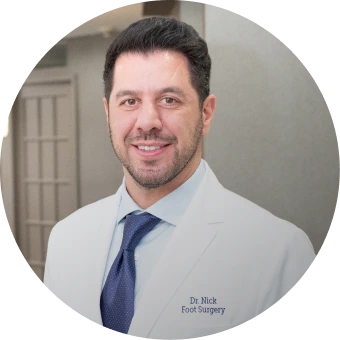
About the Author
Dr. Nick Argerakis
June 26, 2026
Take Your First Step
Get in touch with our team for a free consultation to determine the best path for you.