

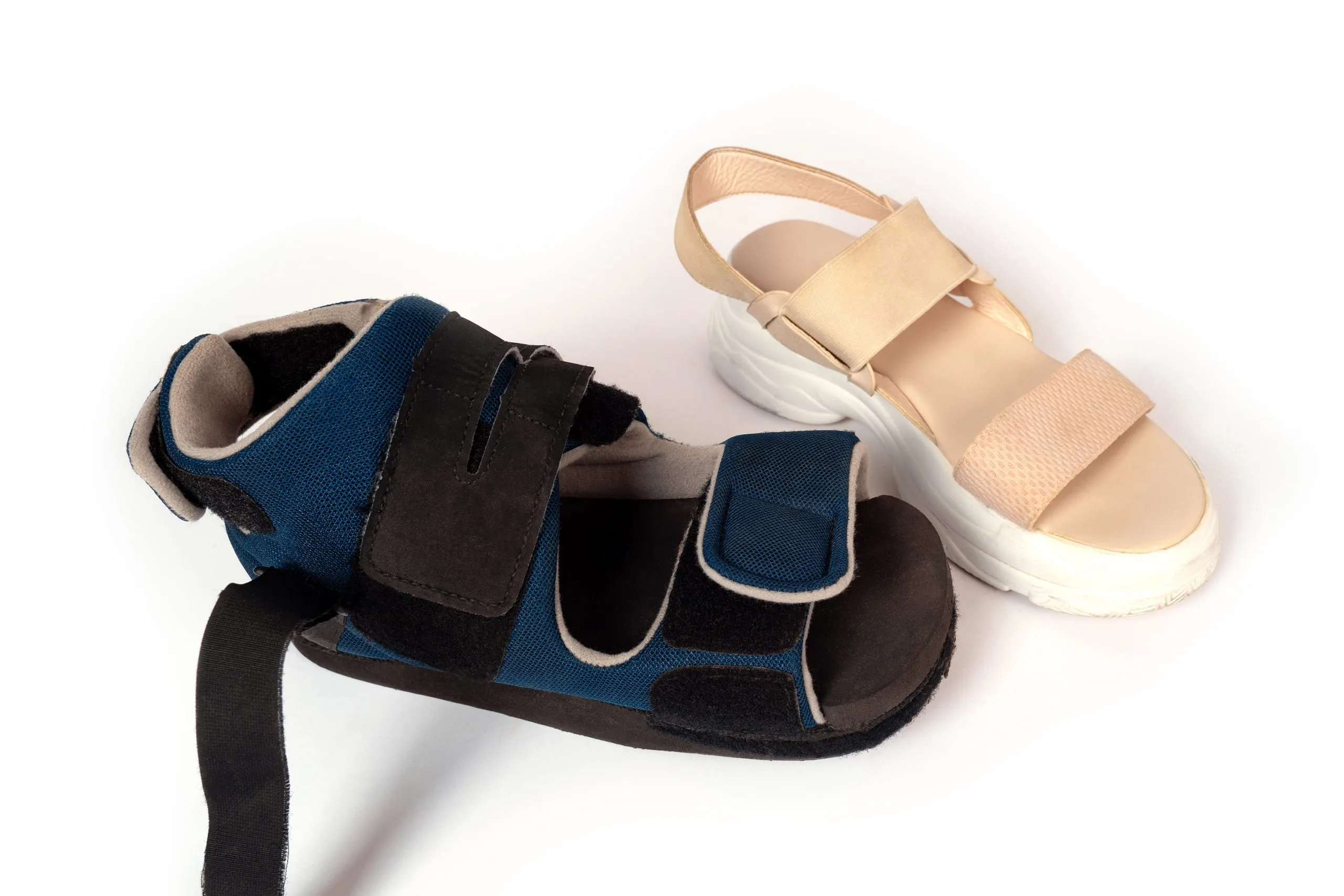
If you are wondering what shoes to wear after bunion surgery, the short answer is this: start in the surgical shoe or boot your podiatrist gives you, then transition to a wide, supportive sneaker with a roomy toe box and a stiff sole. High heels, pointed flats, and narrow dress shoes come last – if at all – and only after your surgeon confirms the correction has fully consolidated.
Footwear is not a small detail in bunion recovery. The shoes you put on in weeks three, eight, and twenty all place pressure on the same joint your surgeon just realigned. At Silverstone Podiatry, our approach to bunion correction is centered on restoring your foot’s proper alignment for lasting mobility – and your footwear choices are a vital part of achieving that goal.
Bunion correction is bone work. Whether the deformity was addressed through a minimally invasive technique or a more traditional osteotomy, the bone needs time to knit back together in its new position. During that window, your shoe acts as an external splint – controlling how much the forefoot bends, how much pressure lands on the big toe joint, and how much the toe can drift back toward its old angle.
There is no single date, because the timeline follows your bone – not the calendar. It also depends on the type of bunion surgery performed, your healing rate, and whether other issues like a hammertoe were corrected at the same time.
A post-op shoe with a stiff rocker sole and Velcro straps. It looks bulky, but it is doing real work – offloading the forefoot, keeping the foot neutral, protecting the incision, and accommodating bandages and swelling. You will wear it continuously, even at rest. Weight-bearing instructions vary by procedure.
Most patients stay in the surgical shoe or a walking boot. Some minimally invasive corrections allow earlier progression. Your follow-up X-rays guide this, not how good your foot feels.
Once your surgeon confirms sufficient bone healing, you move into a running or walking shoe with a wide forefoot, a firm midsole and stiff sole, and laces you can loosen. Expect to wear the same pair for a while. This is a major milestone – but not a green light for all footwear.
As swelling recedes, dress sneakers, wide leather oxfords, supportive loafers, comfortable walking shoes, and structured sandals with adjustable straps come into play. High heels, narrow dress shoes, and flimsy flip-flops are still off-limits. Rushing this stage is a common cause of setbacks.
Most patients can wear a wide variety of shoes comfortably. Some return to a modest heel; others discover they simply prefer supportive shoes and never go back.
If you are researching bunion surgery before scheduling, ask specifically about the footwear timeline for the technique recommended for your foot. Minimally invasive and traditional corrections do not always follow the same schedule.
Often, yes – though usually in width rather than length.
When a bunion is corrected, the first metatarsal is brought back toward the second, narrowing the overall footprint of the forefoot. Many patients find that a wide or extra-wide width they previously needed is no longer necessary once swelling fully resolves. The visible bump is gone, so shoes that used to rub on the inside of the foot no longer do.
Length rarely changes dramatically, but there are exceptions – some corrective procedures shorten the first metatarsal slightly, and a big toe that now sits straight instead of angled can measure a fraction differently.
Two practical rules:
Do not buy a full wardrobe of shoes at the three-month mark. Swelling is still present. What fits then may be loose at eight months.
Get measured again around six to nine months, in the late afternoon when your foot is at its largest. Measure both feet – asymmetry after unilateral surgery is common.
Choosing footwear is easier when you evaluate shoes by structure rather than brand or style. Four features matter most.
A firm heel counter. Squeeze the back of the shoe between thumb and finger. If it collapses, the shoe will not control heel motion, and instability transfers stress forward into the forefoot.
A stiff or semi-rigid sole. Try to bend the shoe in half – you want minimal give through the forefoot. A rocker-bottom profile is even better.
Torsional stability. Hold the shoe at heel and toe and twist. A good shoe resists, protecting the healing bones.
Adequate arch contour. A flattening arch drives extra force into the corrected joint. The shoe should have built-in arch support or room for a custom orthotic.
Laces or adjustable straps are non-negotiable early on. Slip-ons cannot accommodate a swelling foot.
The toe box is where most patients go wrong. Your big toe has been surgically repositioned – it needs horizontal room to stay in that position. A narrow toe box pushes it back toward a deviated position, working directly against the correction.
Look for:
A toe box that is wide and deep, not just long
A shape that follows the natural splay of the foot rather than tapering to a point
Enough vertical room that the upper does not press on the big toe joint
About a half-inch of space between your longest toe and the end of the shoe
A quick test: remove the insole and stand on it. If any part of your forefoot spills over the edges, the shoe is too narrow – regardless of the size label.
Patients who have had additional forefoot work, such as hammertoe surgery or plantar plate repair, need even more depth.
There is a balance to strike: a rigid sole with a soft upper. The sole protects the healing bone; the upper needs to yield around a swollen, sensitive foot.
Breathable mesh and knits work well in the first few months – they stretch and do not press against the incision line.
Soft leather becomes an excellent option once the scar has matured. It molds to the shape of your foot over time, and full-grain leather that feels stiff in the store often becomes the most comfortable shoe in the closet.
Avoid patent leather, stiff synthetics, and any material with a hard seam running over the big toe joint.
A heel does two things that work against a corrected bunion: it shifts body weight forward onto the forefoot, and it forces the big toe joint into extension. Add a tapered toe box, and you have recreated the exact mechanical environment that produced the bunion.
No heels at all until your surgeon confirms bone healing is complete – generally at least six months to a year.
After clearance, keep heel height modest – roughly one inch or less for regular wear.
Reserve any higher heel for short, seated occasions rather than a day of walking around the city.
Skip pointed toes entirely. A rounded or almond toe box with a slight heel is far kinder to the joint.
This matters especially for our New York patients, many of whom walk considerable distances daily. A shoe that is tolerable for dinner is not the same as a shoe for a twenty-block commute.
Buy one excellent pair at the transition point rather than several average pairs.
Alternate shoes daily so each pair can dry and decompress.
Wear moisture-wicking socks without tight elastic across the forefoot.
Elevate your foot at the end of the day; less swelling tonight means better fit tomorrow.
Bring your shoes to follow-up visits so we can check wear patterns and fit directly.
If a shoe hurts, stop wearing it. Pain in a healing foot is information, not something to push through.
Patients often tell us that the freedom to wear normal shoes again was the real goal of surgery – not just the absence of a bump. You can read more of those experiences in our patient testimonials.
Knowing what shoes to wear after bunion surgery comes down to a sequence: a rigid surgical shoe first, then a wide, supportive sneaker with a firm sole and adjustable laces, then a gradually broader range of leather shoes, structured sandals, and boots as swelling resolves and the bone consolidates. Prioritize a wide toe box, a stiff sole, a firm heel counter, and a soft upper. Leave high heels and narrow, pointed shoes for last – or leave them behind. Custom orthotics inside a well-built shoe help protect your correction for the long term.
Silverstone Podiatry treats bunions, hammertoes, and related forefoot conditions in New York, NY, with online scheduling for evaluations. If you have questions about your footwear plan – before or after surgery – bring the shoes you actually wear to your next visit, and we will go through them with you.

About the Author
Dr. Nick Argerakis
July 29, 2026
Take Your First Step
Get in touch with our team for a free consultation to determine the best path for you.